![Shorty Lungkarta Tjungurrayi, Children’s Water Dreaming (Version 2) [formerly Water Story], 1972](https://static-assets.artlogic.net/w_2400,h_2400,c_limit,f_auto,fl_lossy,q_auto/ws-twocollections/usr/images/artworks/main_image/items/5f/5f1c4f9b70c7461588df97e635aeb974/cat24_sltjungurrayi.jpg)
Shorty Lungkarta Tjungurrayi Pintupi, circa 1920-1987
Provenance
The Artist, painted at Stuart Art Centre, May-July 1972
Stuart Art Centre, Alice Springs, Northern Territory, consignment 14, painting 3, cat. no. 14003
Tim Guthrie Collection, Melbourne
Private Collection, Melbourne
Sotheby's, Melbourne, Important Aboriginal Art, 29 June 1998, lot 46
Collection of John and Barbara Wilkerson, New York
Exhibitions
Icons of the Desert: Early Aboriginal Paintings from Papunya, The Herbert F Johnson Museum, Cornell University, Ithaca, New York, 10 January - 5 April 2009; Fowler Museum of Cultural History, University of California, Los Angeles, 3 May - 2 August 2009; Grey Art Gallery, New York University, New York, 1 September - 5 December 2009
Tjukurrtjanu: Origins of Western Desert Art, The Ian Potter Centre, National Gallery Victoria, Melbourne, Australia, 30 September 2011- 12 February 2012; Musee du quai Branly, Paris, France, 9 October 2012- 20 January 2013
Abstraction & the Dreaming: Aboriginal Paintings from Australia’s Western Desert (1971 – Present), Nora Eccles Harrison Museum of Art, Utah State University, Utah, 11 September - 12 December 2015
Australian Consulate-General New York, Official Consul General Residence, New York, 5 October 2021 - 20 October 2022
60 over 50: 60 Paintings from 50 Years of Australian First Nations Art, UOVO, New York, May 2023
Publications
Bardon, Geoffrey, and James Bardon. Papunya, A Place Made After the Story: The Beginnings of the Western Desert Painting Movement. The Miegunyah Press, 2004, p. 487, painting 469.
Connors, Thomas. "Cultural Crossings." The Magazine Antiques, July/August 2025, pp. 130–141.
Merlino, Vanessa, and Luke Scholes. 60 over 50: 60 Paintings from 50 Years of Australian First Nations Art. UOVO, 2023, pp. 40–41 (illus.)
Myers, Fred, and Terry Smith. Six Paintings from Papunya: A Conversation. Duke University Press, 2024.
Perkins, Hetti, and Hannah Fink. Papunya Tula: Genesis and Genius. Art Gallery of New South Wales, 2000, pp. 46, 285 (illus.)
Sotheby's. Important Aboriginal Art. Melbourne, 29 June 1998, p. 37.
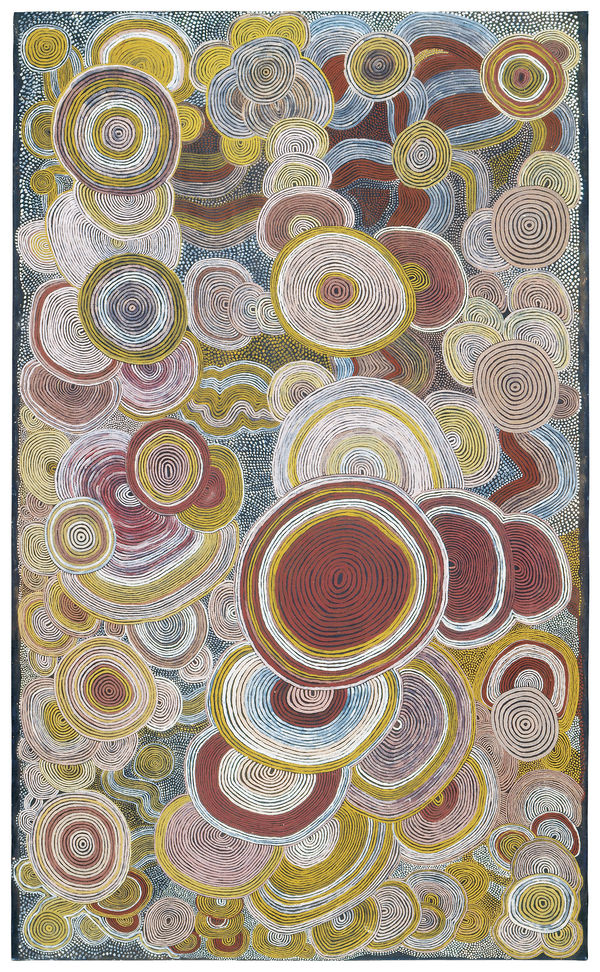
“Widely published and exhibited in Australia and internationally, Children’s Water Dreaming is an icon of the contemporary Aboriginal art movement. Its dynamic composition, use of negative space and linear complexity delivers a compelling image.
Given the cultural and linguistic barriers between the artists and those who acquired the works, the exact subject of some early Papunya paintings remains ambiguous. With Children’s Water Dreaming (Version 2) having been completed in 1972, differing explanations have been offered to explain its significance. Originally it was thought that it referred to the artist’s knowledge of a specific Water Dreaming site, then it was attributed to the artist’s birthplace of Lampintjanya. Most recently, however, it has been suggested that it depicts a human hair spindle used in the manufacture of hairstring for ceremonial purposes.” (Vanessa Merlino and Luke Scholes, 60 over 50: 60 Paintings from 50 Years of Australian First Nations Art, 2023, p. 40)-
 Shorty Lungkarta Tjungurrayi, Mystery Sand Mosaic, 1974
 -
Shorty Lungkarta Tjungurrayi, Tingarri Ceremony at Ilingawurngawurrnga, 1974
-
Shorty Lungkarta Tjungurrayi, Classic Pintupi Water Dreaming [formerly Water Dreaming], 1972
-
Mick Namararri Tjapaltjarri, Tjunginpa, 1991

![Shorty Lungkarta Tjungurrayi, Classic Pintupi Water Dreaming [formerly Water Dreaming], 1972](https://static-assets.artlogic.net/w_600,c_limit,f_auto,fl_lossy,q_auto/ws-twocollections/usr/images/artworks/main_image/items/92/92b007ac9e424af4a354ea967baf27f1/cat25_sltjungurrayi.jpg)
