Emily Kam Kngwarray Anmatyerr language group, circa 1914-1996
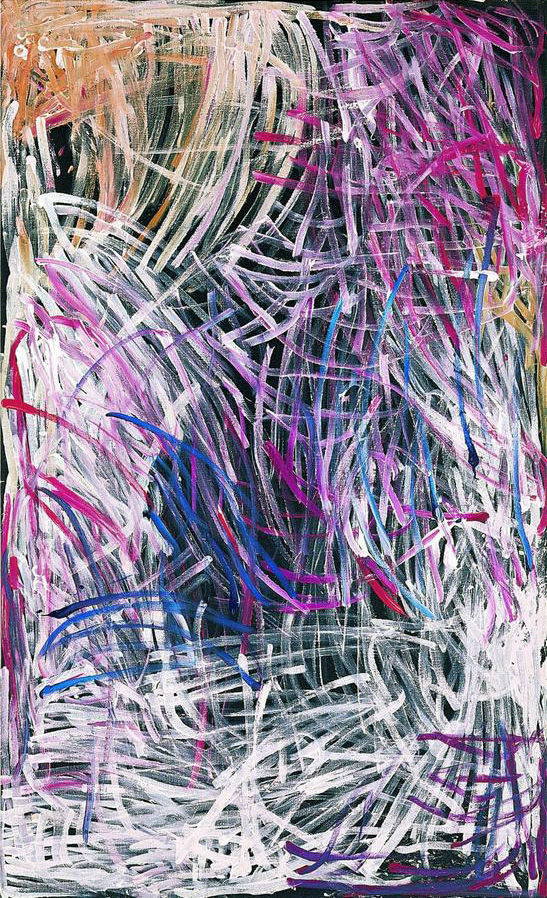
Yam Story, 1996
Synthetic polymer paint on linen
152 × 91 cm (59.8 × 35.8 inches)
© Emily Kam Kngwarray/Copyright Agency. Licensed by Artists Rights Society (ARS), New York, 2026
Provenance
The Artist, painted at Delmore, Northern Territory
Delmore Gallery, Northern Territory, cat. no. 96G007
William Mora Galleries, Melbourne, Victoria
The Applied Chemicals Collection, Melbourne, Victoria, acquired from the above
D Lan Galleries, Melbourne
Collection of Steve Martin and Anne Stringfield, New York, acquired from the above
Exhibitions
Of My Country: Emily Kame Kngwarreye, The Applied Chemicals Collection, Bendigo Art Gallery, Bendigo, Victoria, 1–30 May 1999
Literature
Of My Country: Emily Kame Kngwarreye, The Applied Chemicals Collection, Bendigo Art Gallery, Bendigo, Victoria, 1999 (illus.)
Across a deep black background, frayed flickers of yellow, white and grey clash and burst, filling the canvas with restless, creative energy. Occasional threads of red and pink emerge briefly before being absorbed back into the overall field. The marks are spontaneous and continuous – pushed and pulled across the surface with the full weight of the artist’s arm – and the canvas bears that physical force in every stroke.
The yam – anwerlarr, or pencil yam – holds particular significance in Eastern Anmatyerr Country, especially for Kngwarray, who was its most senior custodian. As a food source that reliably returns after drought-breaking rains, the yam embodies the principle of renewal at the heart of awely – women’s ceremonial practice – through which the land’s fertility is maintained and its spiritual force kept in order. Kngwarray’s gestural marks enact this knowledge, the crisscrossing lines describing the underground rhizome systems, the way growth erupts and spreads outward from central nodes, and the broader logic of a living Country constantly regenerating itself.
Painted in July 1996, the final year of Kngwarray’s life, Yam Story is part of what has been called her ‘Sacred Grasses’ period, the last of several key stylistic shifts over her concentrated eight-year career. Having moved through zones of delicate dotting, vibrant colour phases and bold linear strokes, she arrived in these final years at a style reduced to its core: line, motion, and the yam root system that had underpinned her work from the very start. Those who have observed her practice note that during this time her fist was clenched tightly around the brush as she forcefully manipulated the paint. In Yam Story, the artist returns to her fundamental motif with a force that feels less like repetition and more like confrontation. It stands as one of her most physically commanding pieces from her later years.
—Vanessa Merlino
12
of
12
Related artworks
-
 Emily Kam Kngwarray, Untitled – Alhalkere, 1992
-
Emily Kam Kngwarray, Untitled (Alhalkere), 1990
-
Emily Kam Kngwarray, Untitled (Alhalker), 1993
-
Emily Kam Kngwarray, Untitled, 1996
-
Emily Kam Kngwarray, Untitled, 1990
-
Emily Kam Kngwarray, Song of the Emu, 1991
-
Emily Kam Kngwarray, Untitled (Alhalkerre), 1995
-
Emily Kam Kngwarray, Kame Yam Awelye, 1996