Naata Nungurrayi Pintupi language group, circa 1932-2021
-
 Marrapinti, 2006
 -
Untitled – Karilywarra, 2010
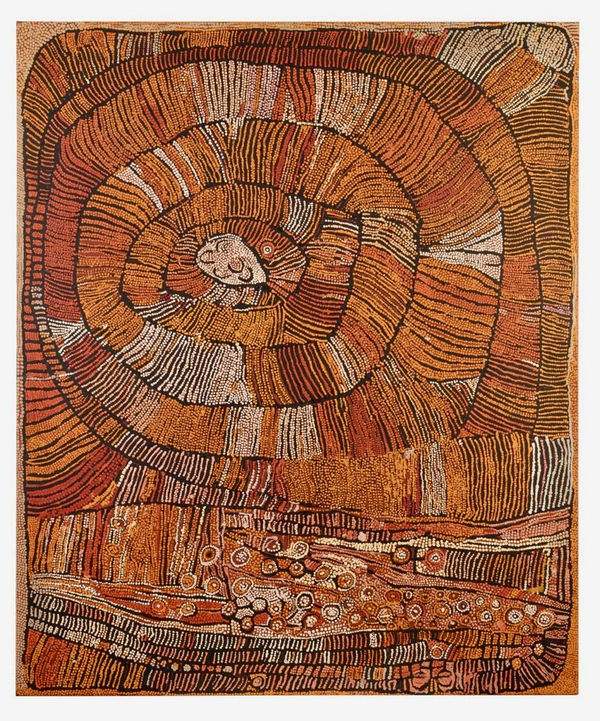


"I am painting my home, my Country— women's Kanaputa story. Traveling along Yirrututu, Tjuntupul, Marrapinti, Ngami, Wirrul."
Naata Nungurrayi in conversation with Marlene Nampitjinpa and Sarita Quinlivan, October 2010
"Naata Nungurrayi was born around 1932 near the rockhole site of Kumilnga, west of Wala Wala in the Pollock Hills of the Gibson Desert, Western Australia. She spent her early years travelling with her parents and sisters across an unforgiving desert environment, moving along Tingarri Dreaming routes that intersect the Pollock Hills. These journeys embedded her responsibilities to ancestral sites including Wala Wala, Ngaripungkunya, Marrapinti, Wirrulnga, Ngaminya, Wanku, Piti Kutjarra and Karilwarra, the latter being the place she always described as her true home. The vast distances travelled by Nungurrayi’s family reflect the epic journeys of the Tingarri ancestors, whose Dreaming narratives dominate the northern Western Desert. The Tingarri stories tell of male and female ancestral beings who carved significant pathways through Country, leaving behind sacred sites, songs and designs. Although many aspects of the Tingarri are restricted, women hold authority over a distinct part of these stories, especially those linked to the Kanaputa women’s Dreaming. In the Kiwirrkurra area, the Kanaputa women journeyed alongside their male counterparts, with sites such as Ngaminya, Marrapinti, Yunala and Wirrulnga marking their paths. These locations still feature in the artwork of Pintupi women, which celebrates female agency, independence and ceremonial life within the broader cosmology of the desert. Nungurrayi’s early life was marked by resilience and loss. She bore two sons in the bush but lost both her daughter and husband during severe droughts. In 1964, she and her family encountered a Northern Territory Welfare Branch patrol and were relocated to Papunya. Like many Pintupi, she longed to return to her homelands, and in the early 1980s became one of the founding residents of Walungurru (Kintore), a community established closer to her ancestral Country. Nungurrayi started painting in the mid 1990s as part of a powerful group of senior Pintupi women who helped reshape the Western Desert art movement. Alongside her contemporary Makinti Napanangka, she broadened the role of women within the movement, both in cultural leadership and in aesthetic innovation. Her works are celebrated for their instinctive energy and distinctive visual language: compositions that merge topographic mapping with gestural abstraction, often marked by armlets, grids, mollusc-like forms and layers of mottled colour. Nungurrayi conveyed the spiritual geography of her Country, illustrating ancestral journeys and ceremonial acts with a mix of cultural authority, artistic spontaneity, conviction and idiosyncrasy. Her work gave form to the feminine aspects of the Tingarri narratives – the Kanaputa – affirming women’s enduring connection to Country and their role in shaping its visual and cultural identity. Through this distinctive visual language, Naata Nungurrayi became one of the most original voices in Western Desert painting – a celebrated artist whose work still resonates with cultural depth and contemporary strength." (Vanessa Merlino and Isabella Wadley, Makinti Napanangka x Naata Nungurrayi, Frieze Masters 2025, p. 31)