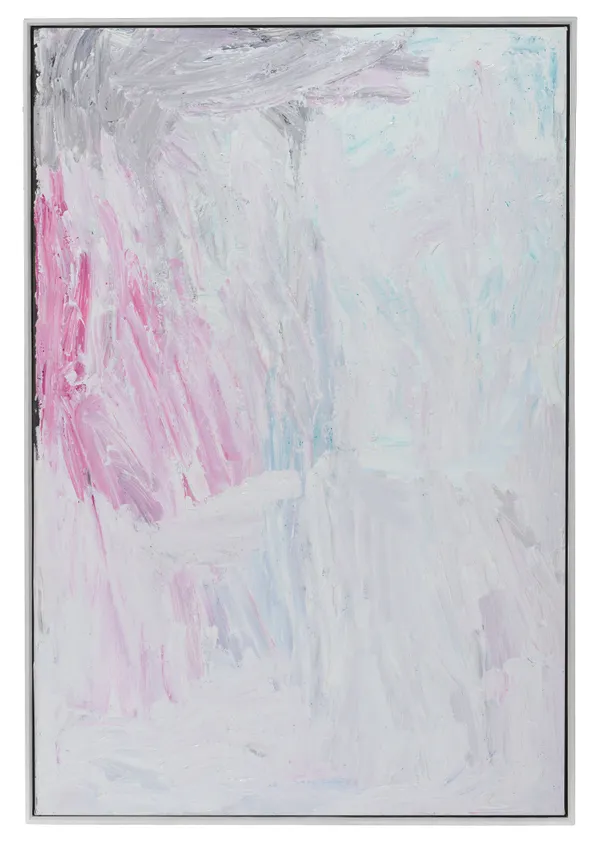
Sally Gabori Kayardild/Kaiadilt language group, circa 1924-2015
Dibirdibi Country, 2012
Synthetic polymer paint on linen
101 × 198 cm (39.8 × 78 inches)
© Sally Gabori/Copyright Agency. Licensed by Artists Rights Society, NY, 2026
Provenance
The Artist, painted at Mornington Island, Queensland
Mornington Island Arts, Queensland, cat. no. 8020-L-SG-1112
Alcaston Gallery, Melbourne, Victoria
Private collection, New South Wales
D'Lan Contemporary, Melbourne, Victoria
Private collection, Victoria, acquired from the above in 2020
D Lan Galleries, Melbourne
Collection of Steve Martin & Anne Stringfield, New York
Exhibitions
Significant, D Lan Galleries, Melbourne/Sydney/New York, 14 May — 27 June 2026
Literature
Merlino, Vanessa, Significant, D Lan Galleries, 2026, pp. 94–95 (illus.)
Mundine, Djon, Gabori: the Corrigan Collection of paintings by Sally Gabori, Macmillan Art Publishing, Melbourne, Australia, 2015, cover, pp. 198–199 (illus.)
Rising from its ink-like depths, luminous sweeps of crimson and white punctuate a darkened field, giving form and dimension to the contours of Dibirdibi Country. Applied with urgency and physical confidence, these marks rise vertically across the horizontal linen, pooling and dragging at their edges, but also extend outward toward the viewer. The central strip of vermillion alludes to the first ray of the morning sun striking the highest point of the sleeping land. Measuring 101 × 198 cm (39.8 × 78 inches), the painting requires peripheral vision and, in turn, evokes an undeniable landscape. There is no horizon, no sense of recession, yet the composition offers a direct, bodily encounter with place.
Dibirdibi Country belongs to Gabori’s late husband, Kabararrjingathi Boltoko Pat Gabori, and is the site of the ancestral being Dibirdibi, the Rock Cod, who, according to Kaiadilt tradition, shaped the South Wellesley Islands, including the largest, Bentinck Island, by digging the earth with his ventral fins. Gabori held the songs, stories and responsibilities of this place alongside her husband throughout their life on Bentinck Island. Created in 2012, seven years after she first picked up a brush at Mornington Island Art Centre, this work reflects the development of a mature and increasingly refined visual language. While earlier Dibirdibi Country paintings used six or more clashing hues to depict the rock-walled fish traps and tidal channels of the gulf, this work focuses its energy upon three main colours, demonstrating the restraint of an artist fully in control of her means.
Gabori described the saltpans of Bentinck Island as the focus of this work, and in reducing her palette, she did not sacrifice any of her power. Dibirdibi Country 2012 ranks among the defining works of her later practice, proof that Gabori’s painting was never abstract in the Western sense, but something intimate and intentional: a mapping of deep knowledge, loss and belonging expressed in paint.
—Vanessa Merlino
Related artworks
-
 Sally Gabori, Nyinyilki, 2011
-
Sally Gabori, Dibirdibi Country, 2010
-
Sally Gabori, Dibirdibi Country, 2011
-
Sally Gabori, My Country, 2009
-
Sally Gabori, Thundi, 2012
-
Sally Gabori, Thundi, 2008