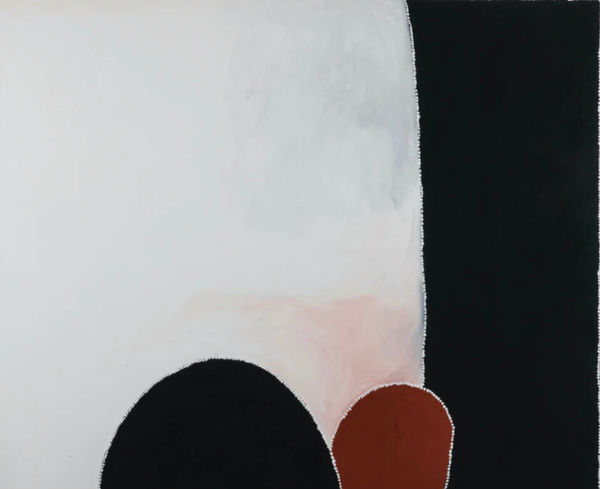
Paddy Bedford Gija language group, circa 1922-2007
Mendoowoorrji - Medicine Pocket, 2004
Natural earth pigments and synthetic binder on linen
59 x 70 ⅞ inches (150 x 180 cm)
© Paddy Bedford/Copyright Agency. Licensed by Artists Rights Society, NY, 2026
Provenance
The Artist, painted in the Kimberley Region, Western Australia
Jirrawun Arts, Kimberley, Western Australia, cat. no. PB 6 2004.173
Private Collection, Adelaide, acquired from the above in 2004
D'Lan Contemporary, Melbourne
Collection of Steve Martin & Anne Stringfield, New York
Exhibitions
TEFAF Maastricht 2025, Maastricht, Presented by D'Lan Contemporary, 15 March 2025 – 20 March 2025
Literature
Merlino, Vanessa, Luke Scholes, and Isabella Wadley. TEFAF Maastricht 2025, D'Lan Contemporary, 2025, pp. 56-57 (illus.)Publications
Michael, Linda, ed. Paddy Bedford. Museum of Contemporary Art, Sydney, 2006, pp. 134, 154 (illus.)
"The title Medicine Pocket refers to Country. The Gija name for this place, Mendoowoorrji, resonates with the Ngarranggarni, more generally known as the Dreaming, the parallel time dimension in which plants, animals and landscapes were created and in which the laws governing much human behaviour were instituted."
— Georges Petitjean, Paddy Bedford, Museum of Contemporary Art, Sydney, 2006, p. 14
"Mendoowoorrji is the general name given to the line of hills between Thoonbi and Thoowoonggoonarrin...an important camping area before the arrival of Europeans. It is part of the artist's mother's dreaming. Two dreamtime men hit each other with sticks there and became part of the country."
— Linda Michael, Paddy Bedford, Museum of Contemporary Art, Sydney, 2006, p. 134
"In the painting Mendoowoorrji – Medicine Pocket 2004, Bedford evokes the narrative that embodies a hillscape...The 'living water' found along these hills is suggested by the luminosity or transparency of his paint, achieved through his wet-on-wet technique...This became a characteristic of his paintings made after 2004."
— Vanessa Merlino, Head of Research, D'Lan Contemporary
Related artworks
-
 Paddy Bedford, Girrganyji The Brown Falcon Dreaming, 2000
 -
Paddy Bedford, Mud Springs - Yuwangeny, 2002
-
Paddy Bedford, Twenty Mile, 2005
-
Paddy Bedford, Blanket Lizard – Motor Car Yard, 2004
-
Paddy Bedford, Bemberrawunay – Brumby Spring, 2004